
Inuvik to Ushuaia
Peru Wrapup
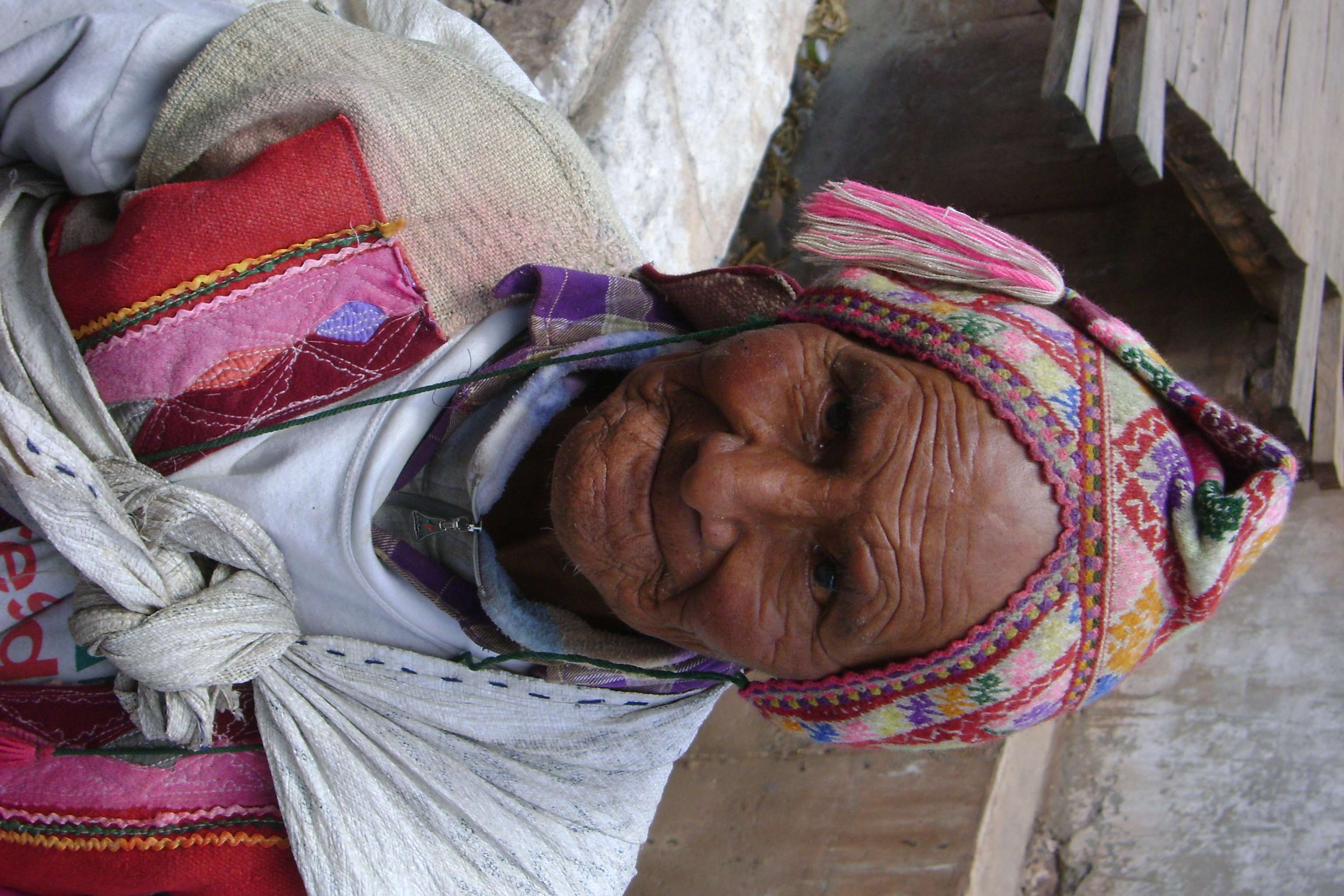
Pictures from southern Peru and Northern Peru are up... And our route maps and elevation profiles are all up-to-date as well.
Peru was a delightful and challenging country for bicycle travel. The people are warm and open and cry out "Gringo!" from every field and household. (This may be rude in "gringo" terms, but it's just friendly banter from most Peruvians. Who knows why everybody does this in Peru!)
It was also a hard country. We climbed to passes as high as we've ever been (4700 meters, over 15,000 feet) and suffered endless dusty dirt roads. The toilets (or rather outhouses) (if they existed) in rural areas were often of the "squatter" type, not the "sitter" type, where you put your feet beside a hole and aim at the hole.
The country is incredibly beautiful, with striking snow-covered mountains, green rice paddies, huge rivers, and everything in between. And, of course, it has Machu Picchu, which has to be one of the world's most beautiful places.
It was cheap most of the time, except around Cusco and Machu Picchu, where they have the squeeze of the tourist down to a fine art.
Some price examples:
- Hotels: US$5-10 for the two of us. Sometimes surprisingly good.
Teetering on the edge! Help us with our decision
Update: See what we decided here.
We need your help! Please vote and help us decide what should be our next step.
After two years and 3 months of traveling by bicycle, we are tired and want a change or need a change. Our not-so-young bodies are complaining of the day and day out pounding of the roads of South America. But more than that our not-so-young minds are so full of what we've seen and done they don't seem to want any more. We have pedaled over 21,000 kilometers (13,000 miles) and bused, boated or hitched another couple of thousand kilometers. We have climbed many 4000 meter (13,000 foot) passes, pedaled to incredible beaches, passed months after months of farmlands filled with scattering of adobe homes and animals, sweated in the deserts, swatted the swarms of nasty bugs, visited cities, towns, tiny villages, churches, ancient ruins, museums and talked with thousands of people from many different walks of life. The turbulent economy has rocked us all. Even though we are in Bolivia, one of the poorest countries in the Americas, the financial situation in the US has affected our travel funds.
We are turning to of our loyal followers for support and advice in our moment of need. Please write to us and let us know what your advise to us would be.
Here are our options, as we see them:
End the trip here in Bolivia and head back home. read more here... lee mas aquí... »
Our Plan: To Uyuni and the Argentine Border by Bus
Thanks to all of you for your wonderful advice! After a week of resting in La Paz, Bolivia, here's what we have decided to do:
Tonight we're taking an all-night bus to Uyuni, in southern Bolivia, where we'll see the amazing Salar de Uyuni. After a few days there we'll take a train or bus to the Argentine border and ride south on the bikes to Salta, Argentina. In Salta we'll probably take some more time off, perhaps a month or so. Randy will try to pick up some work on the internet doing some web development, and Nancy will be refreshing some of her skills and doing some more drawing. Then we'll probably head south on the bikes and continue the ride.
Thanks so much for your care for us and for your encouraging comments!
Love,
-Randy and Nancy
Riding around Lake Titicaca and into Bolivia
We rode from Puno, Peru to La Paz, Bolivia mostly along Lake Titicaca where the high-altitude lake reflected silver sunlight off the deep blue-green water. During the ride we saw villages harvesting reeds to make into mats, individuals making fishing nets, groups of people preparing the earth for the planting of potatoes, with mostly human power or oxen, but a few had the benefit of using tractors. The first night out of Puno, we outraced a tremendous storm and dove for cover in Ilave after riding 35 beautiful, flat miles. It was so good to be in a hotel room, dry, and safe from the blasting winds and pounding rain which lasted for most of the late afternoon and evening. The next day when we awoke the sun was shinning and the skies were clear. We rode another 49 miles enjoying vast open altiplano which was a wide open valley of dry flat fields. The closer we got to the Bolivian border the more we saw sheep and llamas grazing in the open valley. We even stopped for a photo shoot at the market in Juli where the livestock market was full of sheep and llamas. I saw live sheep hauled up on to the roofs of mini buses and lashed down. I watched as they stuffed live llamas inside the buses. I found it amusing to see a big bunch of live giant sheep on top of a van and a heads of llama sticking out an open window as the buses called colectivos drove past us. I was glad I was not one of those animals.
We stopped for the night in the last town in Peru called Yunguyo before we crossed into Bolivia. To our delight the town was celebrating the fiesta of its patron saint. read more here... lee mas aquí... »
Blazing into Argentina (by bus and train). 5121 Kilometers to Go!
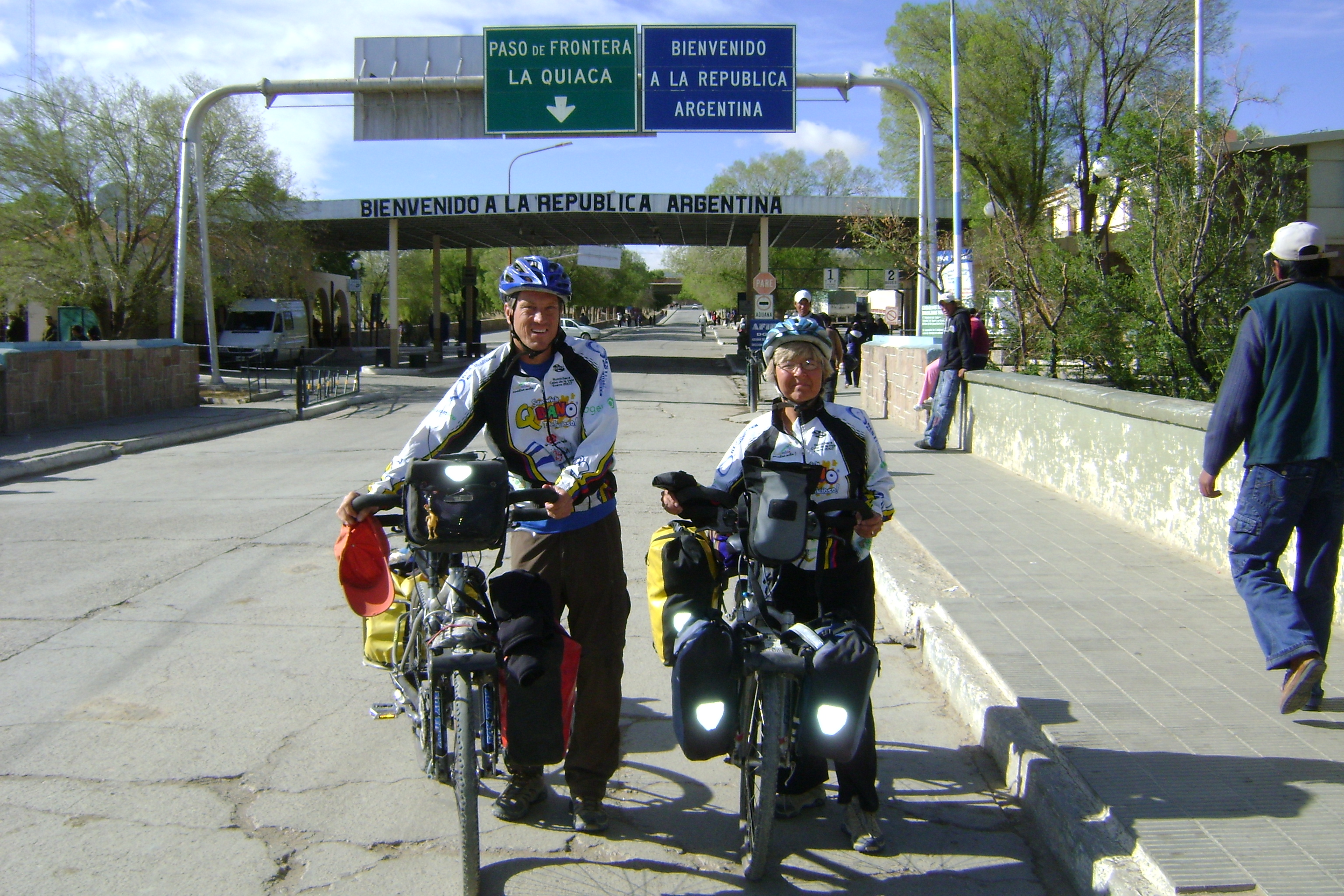
We crossed the border from Bolivia into Argentina today after spending all night on a very comfortable train. Well, at least it was a well-run, clean, on-time train.
Here's the sign that met us at the border, telling us how far it is to Ushuaia, our goal? at the bottom of Argentina:

A 3 day tour of the Salar de Uyuni, Bolivia - a salt desert
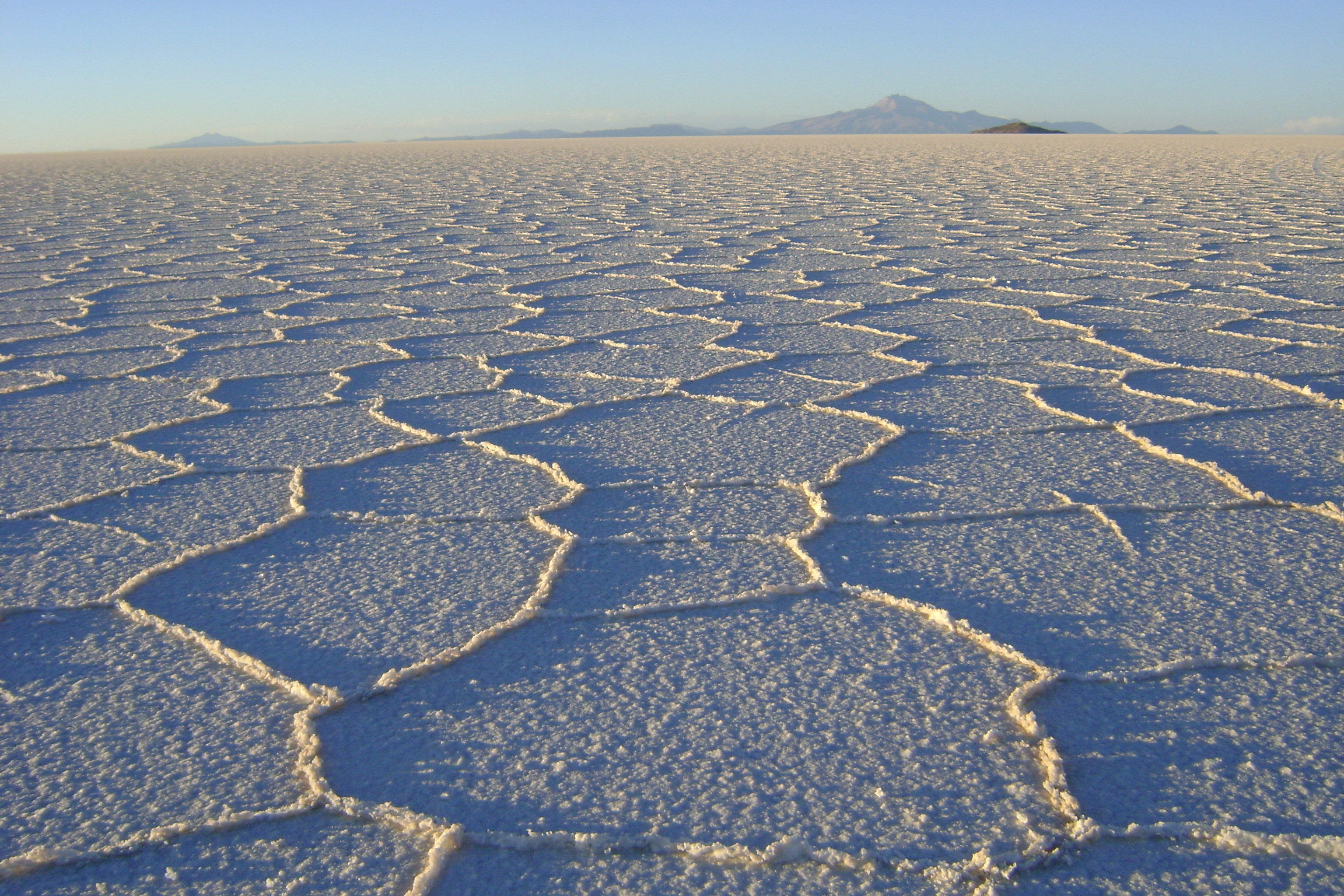
Our 3 day tour around Bolivia´s famous Salar de Uyuni, a massive salt desert, is best described by photos. Because of the difficult terrain, high elevation, remoteness, and extreme cold, we decided to explore this amazing region of southwestern Bolivia by 4x4 vehicle. We went with a tour company called Andes Salt Expedition . They provided all the transportation, food and lodging and expert interpretation in English about the surreal desolate geography we encountered along the way. They delivered what they promised and at a fair price. read more here... lee mas aquí... »
A perfect ride down from the highlands of Bolivia into Northern Argentina, Jujuy
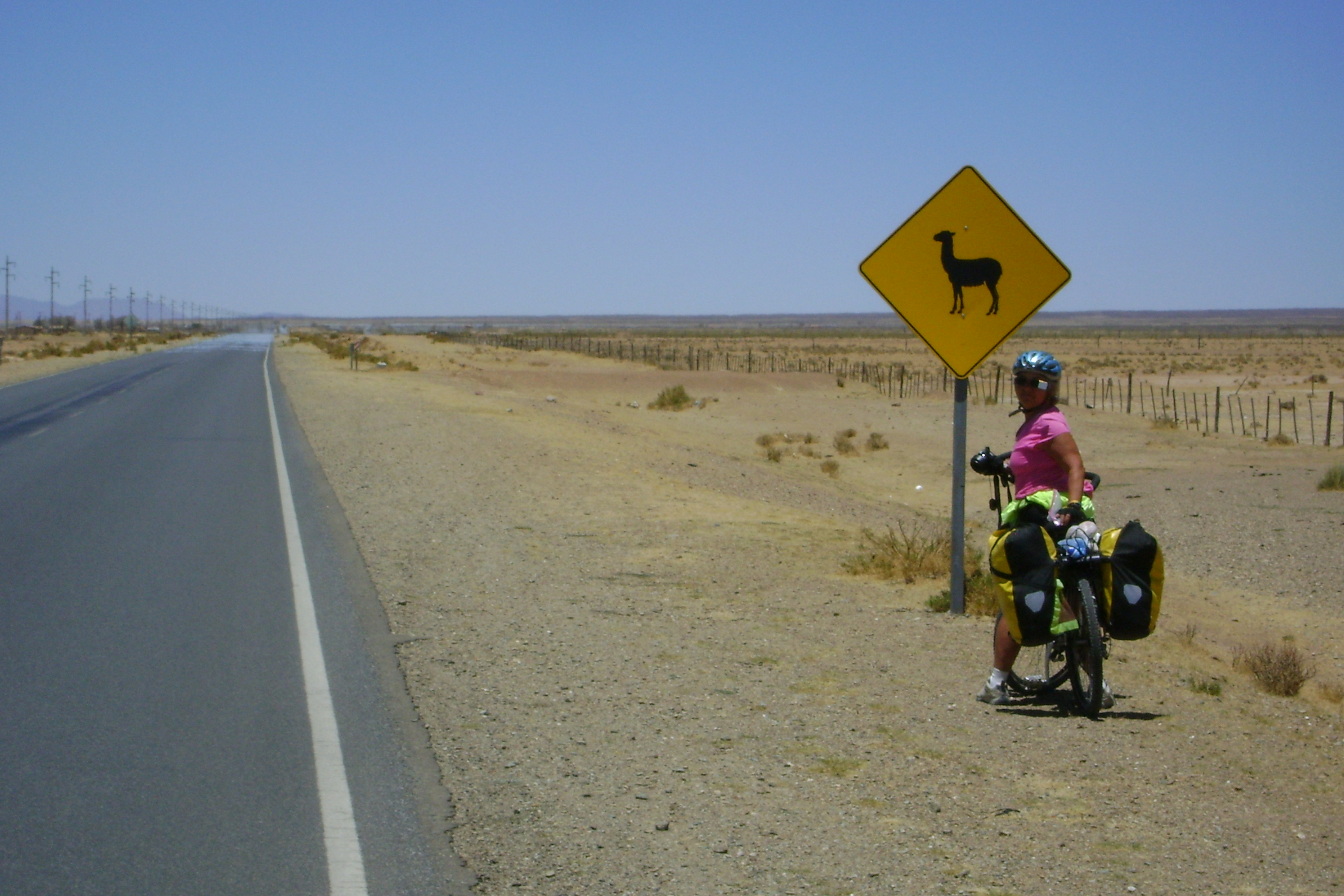
We started our descent from the Altiplano at about 3800 meters where the air is thin and sometimes seems almost non-existent. I never did get acclimated to the high elevation even after almost 3 months. So riding down to the lower lands was very exciting to me, I had hopes I would get my health back and my motivation to ride. This section was going to be downhill. Yes down, down, down. I enjoyed the ride downhill for all 4 days. It had a very satisfying feeling. The road was paved, smooth and no traffic to speak of. The land was open range with llamas grazing everywhere. Instead of having the yellow road signs, "watch out for cows", there were a signs with black silhouetted llamas. I think llamas have about the mental capacity of cattle. Llamas must have suicide tendencies because herds of them keep running across the road just as cars where coming. I imagine they dared each other to run across just as the biggest, fastest bus was approaching and cheered each other when they made it alive to the other side and just went back to grazing when one did not make it.
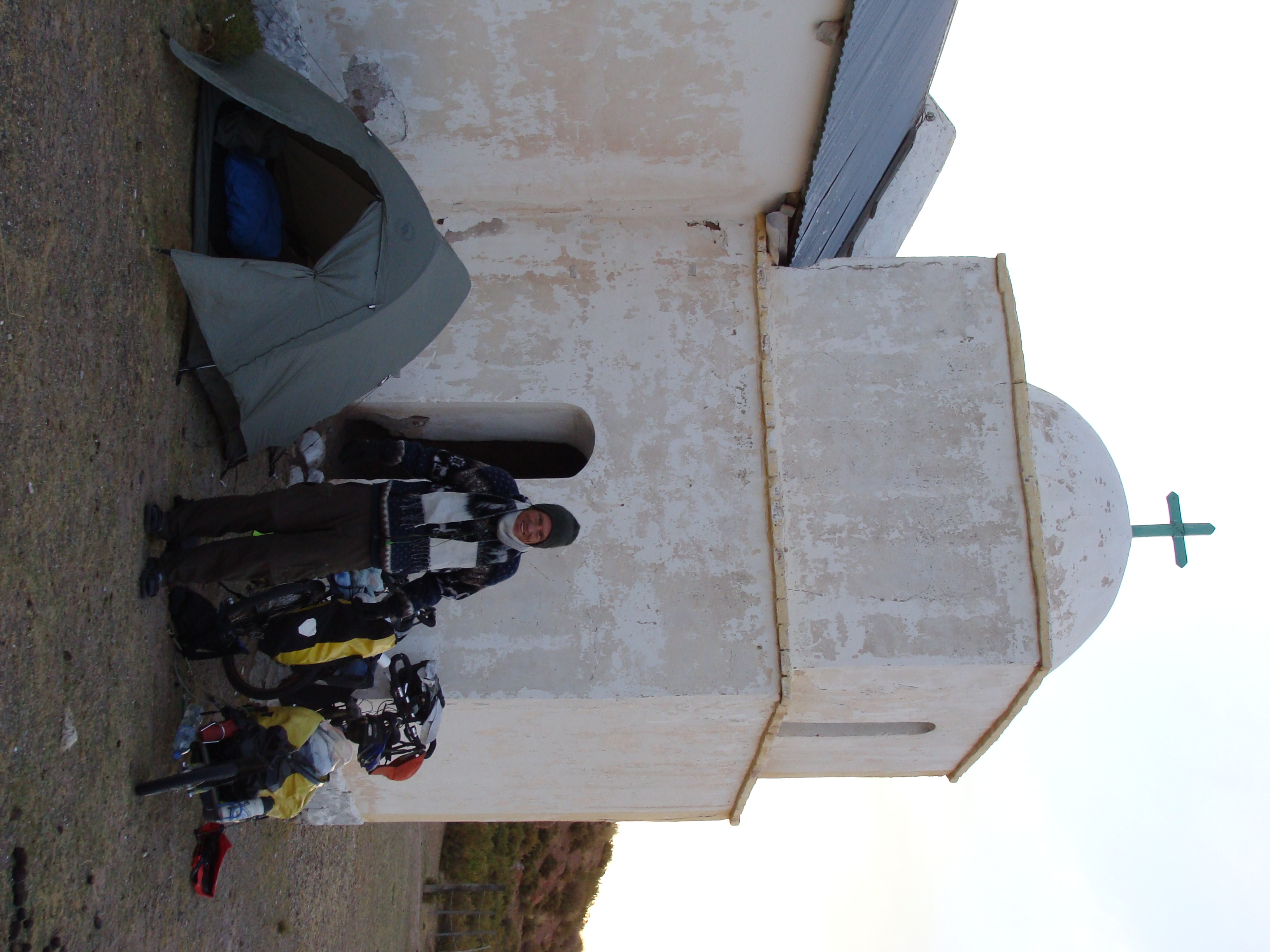
The first day, the winds were quiet and we got in about 100 kilometers. At the end of the day we found an little old adobe church and set up our tent on the quiet side out of the wind and out of sight from the traffic. We cooked dinner inside the bell tower, and watched the sun setting over high grassy plains. read more here... lee mas aquí... »
First impressions of Argentina
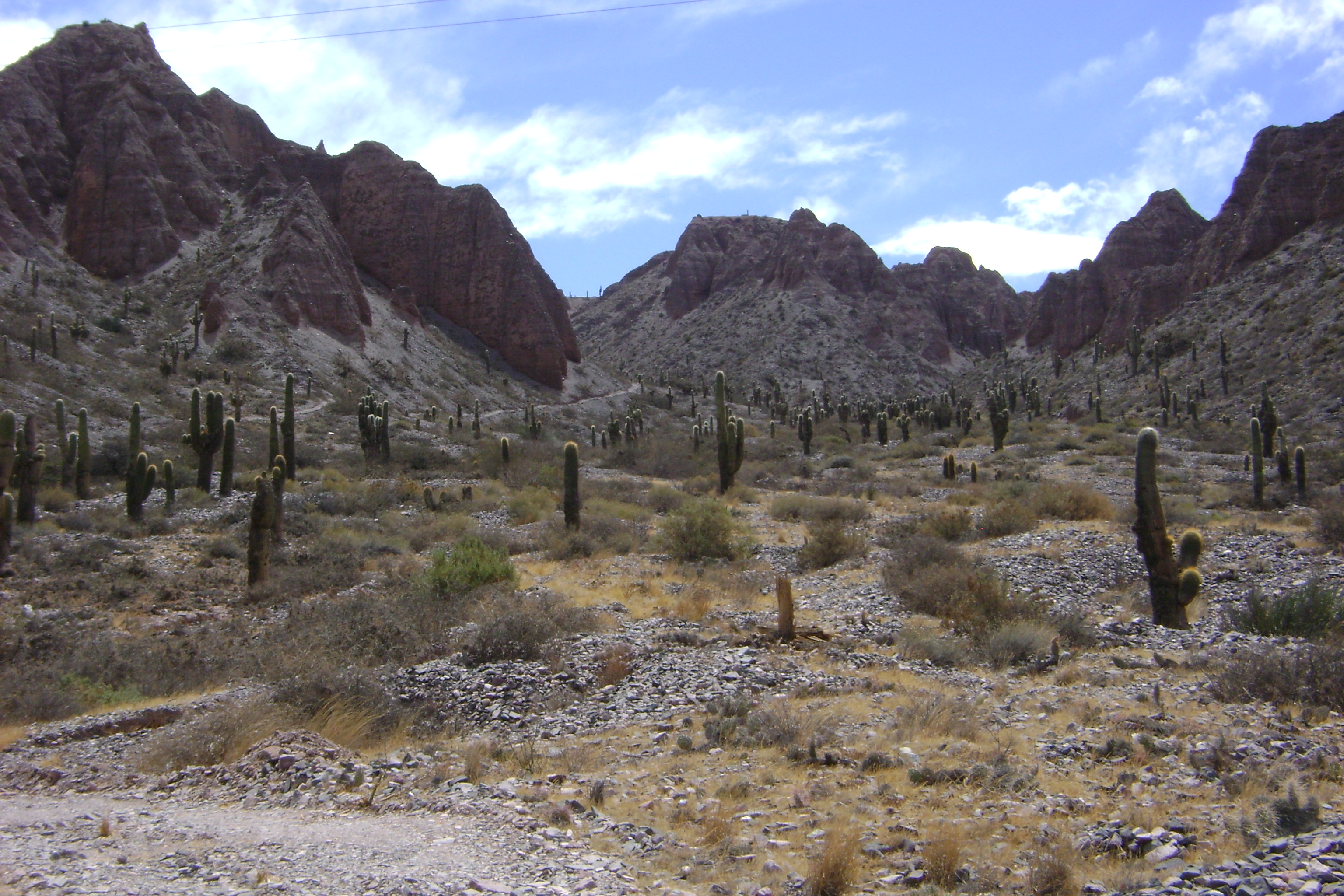
Now that we have been in Argentina for a bit over a week, I have noticed some differences I would like to share. Wine flows more freely than water and is way cheaper than bottled water. I haven't really found good wine since the USA so this land of wine and honey is a great place to buy very good wine at a fantastic price. I wish I knew which wine vineyards are the best. (If you have a recommendation of some of the better wines let me know.)
Water can be drunk directly from the tap all over Argentina! No more buying plastic bottles of water and adding to the world's plastic waste.
We have entered into the land of refrigerators so we can buy cold cuts and cheeses, and refrigerated yogurts. We are now preparing sandwiches for lunch instead of the lunch specials or menu del día found in most of Latin America. The lunch specials usually consisted of rice, french fries, yucca, chicken or beef with a soup as an appetizer with rice, potato, stock and some kind of chicken or beef all for an amazing price of a dollar or two. Argentina's lunch specials are far more expensive than we've had in the rest of South America, at 3 or 4 dollars. They eat around 2:00pm, take 3 hours off and then start the evening feasting and entertainment around 9:00. We went out for dinner the other night to have our first Argentinan steak. At 8:15 we were the first ones in the restaurant that night and they had to turn on the lights for us. Most Argentinans eat dinner about 9 o´clock or 10 o´clock at night. read more here... lee mas aquí... »
Argentina and Chile
Argentina and just a bit of Chile.
Each day has elevation profile, map, and GPS information.
Other resources: PDFs of daily route notes from Florian and Rebekkah are gems of information. These are rehashes of a set that has been carried by many cyclists.
| Ride | date | miles/km | Elev ft/mt |
|---|---|---|---|
| La Quiaca to Camp near Tres Cruces (Capilla Vieja) | 2008-10-26 | 60/97 | 1289/398 |
| Capilla Vieja to Humahuaca | 2008-10-27 | 39/63 | 869/268 |
| Humahuaca to Camp near Purmamarca | 2008-10-28 | 38/61 | 429/132 |
| Purmamarca to Jujuy | 2008-10-29 | 43/69 | 718/222 |
| Jujuy to La Caldera | 2008-11-01 | 45/73 | 2068/638 |
| La Caldera to Salta | 2008-11-02 | 17/27 | 462/143 |
| Salta to Vaqueros | 2008-11-05 | 9/15 | 200/62 |
| Vaqueros to San Lorenzo, Argentina | 2008-11-08 | 10/16 | 600/185 |
| San Lorenzo to Chicoana | 2008-11-18 | 37/60 | 718/222 |
| Chicoana to Alemanía | 2008-11-19 | 43/69 | 1492/460 |
| Alemanía to Cafayate | 2008-11-20 | 52/84 | 2788/860 |
| Cafayate to Amaicha del Valle | 2008-11-22 | 42/68 | 2066/638 |
| San Martín de los Andes to Pichi Traful | 2008-12-06 | 39/63 | 3000/926 |
| Pichi Traful to Espejo Chico | 2008-12-07 | 20/32 | 1692/522 |
| Espejo Chico to Bariloche, Patagonia, Argentina | 2008-12-08 | 17/27 | /0 |
| Bariloche to Casa Pangue, Carabineros, Chile | 2008-12-30 | 22/35 | 1500/463 |
| Casa Pangue to Ensenada, Chile | 2008-12-31 | 23/37 | 600/185 |
Toll Roads and Cyclists in Latin America
Cyclists occasionally ask us about our experience on toll roads in Latin America, so I thought I'd give a little overview. We've ridden on many of them without trouble.
Throughout Latin America roads have been "privatized", giving a concession to a private company to operate them for a period of years. In general, this means better maintenance on the roads.
We have never been asked to pay a toll on any of the roads we've traveled from Mexico to Argentina. However, we have heard of cyclists being required to pay on some roads in Mexico.
Also in Mexico, we avoided the toll roads but occasionally took them. (We find that the toll roads there are fast and fancy, but you get no sense of the culture of the country.) There was one road (from Pueba to Oaxaca) that was rumored to exclude cyclists. Also, the road from Tijuana to Rosario in Baja California is supposed to rigorously exclude cyclists, forcing them onto a very dangerous, narrow alternate.
In our experience, though: We haven't been excluded from any toll roads, and we haven't been charged tolls.
On occasional, in Mexico and again in Peru, there were specific procedures they wanted us to take when approaching a toll booth. They did not want us to go through the auto lane (because we'd register on a camera?) but rather go completely around the toll booth installation. One time in Mexico, not understanding this, I approached too close and the guard did raise his gun for my benefit.
