
Inuvik to Ushuaia
Guatemala's GNP: Cellphones and Politics
Judging from the number of places that sell cellphones and prepaid cards, cellphones must account for about 50% of the GNP of Guatemala. Today we were out in a pretty remote village where the women scratch together money to rent a small plot on which to grow onions. They have next to nothing. But a phone rang somewhere and our hostess pulled a cellphone out of her brassierre...
Escuela Para todos: School for Everybody
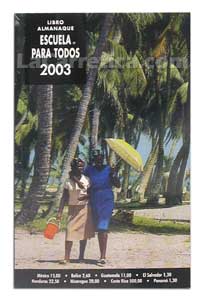
Nancy's been laughing at me for weeks now because I've been devouring a little "almanac" I bought in Chichicastenango, which cost me about $1.40. It's a little book maybe a little like the Old Farmer's Almanac, but with more content and, for me, more cultural insight. The "Escuela Para Todos", or "School for Everybody", is published in Costa Rica expressly for the rural people of Central America, and I've learned so much about rural life from it. It's written at a fairly simple vocabulary level and also has pictures, and those of course help me with the language. If you're studying Spanish, this is the best little reader I've ever come across.
But it's the content that has enthralled me. There's the history of Central American independence, and how it was all one country at first, and how some would like it to be that way again. And how mosquitoes do their dirty deeds and how to prevent the spread of Dengue fever. And how to make concrete posts for fencing and improve the grass in your pastures, all things I never thought much about.
But the very best piece was a little mini-novel telling the story of a girl who got married when she was already pregnant by another man. It turned out OK in the end. read more here... lee mas aquí... »
A Not-So-Good Interview in San Francisco Javier
Morning Road Near San Francisco Javier
This morning we woke up at 4am to catch a microbus from Nebaj, Quiche, Guatemala to interview a group of women in San Francisco Javier. The reason for the interview is to write the story of their business and lives in order to help obtain microloans on Kiva.org for Friendship Bridge in Guatemala. The rain was pouring as we made our way through the deep puddles of the dark streets. Only a few people were out at this time of the morning, walking in the rain underneath thin plastic sheets and clogging along in the total rubber boots so many of the campesinos wear in the fields. A few men hid in the shadows trying to stay dry or sobering up from the night's celebration. This week is the town's annual festival for its patron saint.
We got on the bus a little after 5am. It plowed out of town and followed a rough dirt road for about an hour. The darkness was made more intense by the low clouds that surround this incredible volcanic landscape. The morning light seeped though the misty morning. Clouds obscured most of the surrounding mountains but we got an occasional glimpse of the top of a-not-so distant volcano.
Do any of you have cameras to spare? And monthly update...
We'd like to ask your help with something: We're coming home for a visit next month and we're going to try to get together 12 digital cameras for Friendship Bridge to use to continue the work we've been doing, posting profiles on Kiva.org to raise loans for the women. Do any of you have digital cameras that you don't want any more? We don't need this year's model - in fact, 2-5 year old cameras would be great. If you have one that you could send to Denver, or if you would like to donate money to this cause, please let us know at randyAndNancy@hobobiker.com. All 12 cameras could probably be bought new for around $1200, but used cameras should work fine too.
We have new photos on the website,
A Weekend Ride to Antigua Guatemala
Fancy bike gear: Sandals
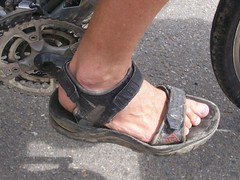
By the way, both of us abandoned fancy clipless pedals and shoes some time ago (like in Victoria, British Columbia). For me, it's just that I want only one pair of shoes, and a clip isn't a very friendly thing on your one pair of shoes. For Nancy, it's that she never does get all that confident about the clipped-in thing. Anyway, we're just normal people with normal shoes these days. Or sandals, that is.
The amazing wood carriers of Guatemala
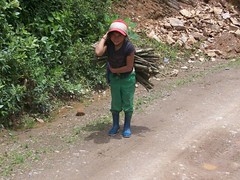
This boy said he had only a 1-hour walk with his load, but we know many carry their loads farther. Some are gathering wood for their own use, but many people are also gathering the wood for sale and carrying it many miles, since it's the only way they have to earn a little cash.
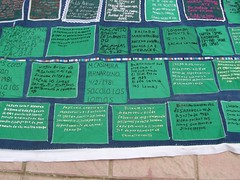
Patchwork quilt to honor the dead and disappeared of the civil war
Evangelicals and Catholicism in Guatemala
A Day of Joy and Poverty
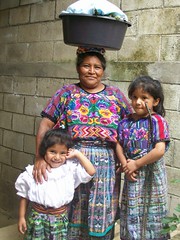
It took us two hours to get to the meeting in the morning. We took a bus, walked 45 minutes up along a mountain ridge and then tromped through a maze of cornfields, farm land and dirt paths. Even though we were 45 minutes late, the women were delighted to see us. No gringos had ever come to visit them in their homes and asked questions about their daily lives. They were all very welcoming and excited to talk with us and have their photos taken. They were also glad to see us because the head of the Chimaltenango office of Friendship Bridge brought the checks for their next 6-month loan. The women were quite happy with this day. The atmosphere was charged with good vibes.
