
Tips for Travelers
Security and Safety in Mexico
We've told you about the highways and our greatest risk in every country - the traffic. But many of you were most worried that we'd be abducted by drug-traffickers or thrown in prison by the "federales." And some have asked us why we weren't bringing a gun (Don't bring a gun to Mexico! You'll go straight to jail if it's discovered at a border crossing!).
In terms of our everyday experience, we have to tell you that Mexico seems to be the safest country we've traveled in on our trip so far. Our perceived level of risk both to person and property is lower than in either Canada or the United States. Nobody has bothered us or our stuff in any way.
Now we'll have to admit that we're not careless travelers and we keep our eyes on our things and don't leave our bikes unattended. We're experienced third-world travelers. And if somebody says an area is dangerous, we listen carefully and try to evaluate the risks. And we also have to admit that we aren't likely to be seen as good kidnapping subjects, since there's nobody to ask for a ransom. Most people here think our bikes are pretty cool, and pretty expensive by Mexican standards, but they don't seem to think we have all that much money (or we'd be going by car, right?) So maybe our risk level is lower because we're a small target. But I don't think so. I think Mexico is just a mighty calm, friendly place.
The other day I read the US State Department's advisory about Mexico. It could get you *really* scared! read more here... lee mas aquí... »
Nancy's tips on riding the roads of Latin America
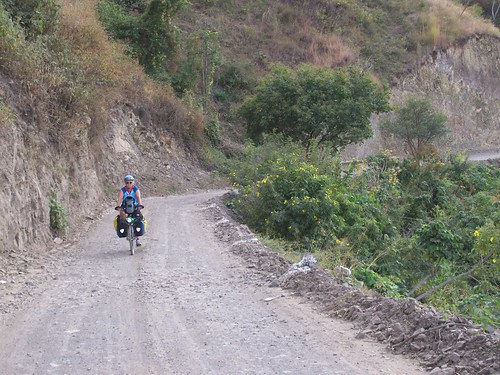
I wrote this in response to a letter of consternation from one of the few other women (and one of the very few other "mature" couples) riding a route like ours in Latin America. It seemed worth while sharing with you, my management technics on how I managed riding the roads of Latin America.
This intrepid rider sent a note saying that the roads of Mexico were freaking her out so she was hopping on buses to avoid certain stretches and was having a difference of opinion about the risk level of the roads with her husband. Here is my response, such as it is:
First of all, I do think you have great amount of courage and smarts and capabilities. I admire you on many accounts. Anyone that has ridden Copper Canyon the way you you did has my admiration. If I knew you better, I might be more comfortable telling you that you have balls.
In retrospect, after riding through Mexico, Guatemala, Honduras, Nicaragua, and Panama, my thoughts about riding in Mexico are that it is a difficult country to ride in, especially as you get closer to the cities. The bigger the city, the more aggressive the drivers, and less room for mistakes.
Politics and Security in Colombia
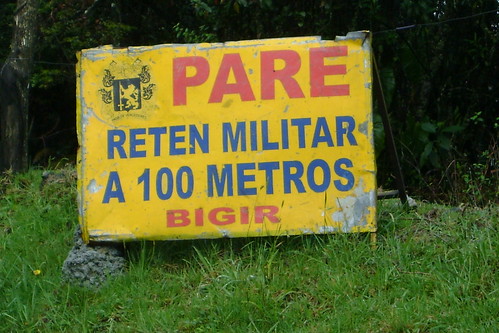
You´ve all heard of Colombia and the tremendous security/drug/paramilitary/guerrilla problems they´ve had over the years. Some of you told us not to go here because of what you had heard. We decided to go, however, because of what we heard from the cyclists who had actually passed through: it´s a calm country, beautiful, with incredibly friendly people. And that´s what we´re finding too. We haven´t had any problem, but we do read the paper and we do see the results of the strain they´ve had over the years.
Basically, Colombia got buried under the corruption of drugs and the challenge of a revolutionary insurgency for decades. They seem to be digging their way out over the last ten years or so, and the current president, Alvaro Uribe, is immensely popular for the progress he´s made. The guerrilla group, the FARC, is still there and still holds some very important hostages, some that it's had for more than 8 years. But it seems to be declining in power and influence. You might wonder from reading the paper that their primary reason to keep holding those hostages is that it's their last grasp on power. The FARC seems to be still quite dependent on the drug trade for its financing.
During the guerrilla years, private security forces were created by the big landowners, and developed into what's called "paramilitary forces" here. Essentially, they became private armies in their own right. read more here... lee mas aquí... »
Health, Healthcare, Health Insurance, and Vaccinations for the big ride
People often ask us about health-related issues, so here are some answers.
Health Insurance: Since we are from the US, with an immensely expensive and burdensome healthcare system, we felt that we had to carry health insurance that would cover us there. Although we might be able to cover expenses for most types of events in the other countries of our journey, a single week in a hospital in the US can easily bankrupt anyone. So we carry normal (expensive) major medical, high deductible ($10,000) health insurance that would cover us if we had to go limping home for a major chronic illness or something. But that insurance doesn't cover us outside the US, so if we had a serious accident or something, we could end up without coverage. So we also bought health insurance that covers us outside the US (cheaper by far). Our monthly expenses for health insurance are probably the biggest expense of the trip.
Note that "Trip insurance" is not worth much for a trip of this size, since it is not renewable and typically has pretty serious limitations. It's oriented to people going on vacation, not to people living abroad. What we needed (and most travellers will need) is the type of insurance that expatriates buy. The folks at Global Insurance Net make a specialty of this type of insurance, and we were pleased with their expertise and service.
Health Care: We've been pretty pleased with healthcare everywhere we've been. read more here... lee mas aquí... »
Camping Versus Hotels in Latin America
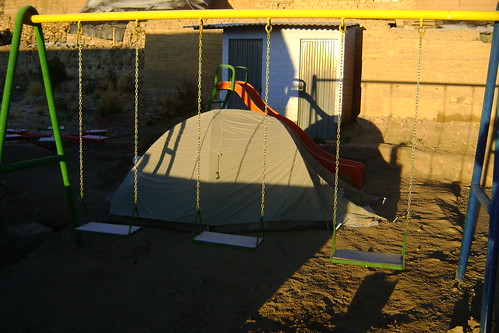
When other cyclists told us we would probably spend a lot of nights in hotels in Latin America, we kind of scoffed at them. As seasoned bike tourists, having camped all over the US and Canada, we figured we'd be camping more than most.
But we have been staying more than 80% of the time in hotels in Latin America (although that number is declining as we get farther south). People ask about this, so we thought we'd tell you why.
Camping in Latin America is different from camping in the US and Canada. There are no (or almost no) "official" campgrounds. It's really rare to see anything like that, and when you do, it's often more expensive than a hotel. And there is almost no "unclaimed" land, like in the western US or Canada. In the US and Canada, if you see a quiet place, you can just set your tent up there (if you're discreet) and nobody will ever know or bother you. In Latin America, almost everything is "owned". One time we set up discreetly behind a horse barn in a Mexican pasture right at dusk. Since we had run out of options, we just set up. We were immediately discovered. Some kids came and checked on us right away. Nobody bothered us, but we were not succeeding at hiding out. read more here... lee mas aquí... »
Bike Maintenance In Latin America
People sometimes ask us what kind of bike we recommend, and how we manage bike maintenance. Here are some thoughts.
Ride a bike that's maintainable. In Latin America, that means a 26" mountain-bike style bike with standard components (V-Brakes or cantilever brakes, not disk brakes). You can buy 26" tires and tubes in even a small town, and you can find a mechanic who will have at least some tools for working on your bike. In a medium-sized town, you can get a rim and maybe spokes. If you have a 700cm wheel, you may have to send away to the nearest capital city and wait for a few days to get some of these things. Some people with difficult-to-obtain parts have spent lots of money on international shipping (and then on customs duties) and have waited ages to get going again when they've had a failure.
Ride a bike that's strong. It's better to be heavy than fragile. Get 36-spoke wheels (we're committed to this after a long failure of a 32-spoke back wheel in Canada. We haven't had a broken spoke since we switched to 36 spoke wheels). Get straight-gauge, strong spokes.
Carry a few spare parts. You can't carry everything. We always have tubes and patch kits, some spokes and the tools to replace them. Many people carry a spare tire. We don't, at least until now.
Keep the bike clean. We think that a bike that's clean doesn't wear as fast, especially the drive train. About every month, more in dusty dirt roads, less on clean pavement, we take our bikes and clean them and completely clean the chain and drivetrain. read more here... lee mas aquí... »
Gringo is not a bad word, and other misunderstandings
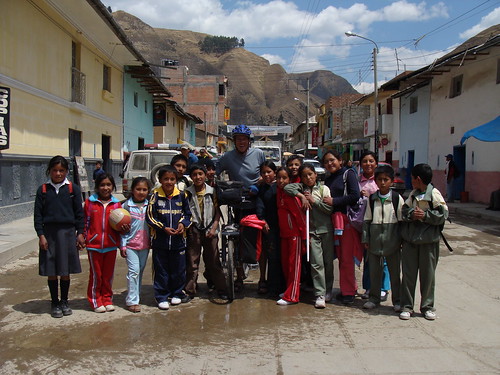
Everywhere we go in Peru the children cry out "Gringo!" It has happened in lots of countries, but they're SO enthusiastic about it here. Some cyclists misunderstand this cultural phenomenon and think that "gringo" has a negative context (or only applies to North Americans). It's just not true. Gringo is just a regular descriptive term, and everywhere we've been it just describes people who talk funny, wear funny clothes, have a funny walk, and probably have money. That even includes people from Chile, and can include kids from the city who dress like gringos.
Some people have heard the story that "gringo" was something said in Mexico during the various US invasions, and it referred to the green uniforms of the invading US troops, and they were saying "Green Go Home" or something. Well, it might be true (nobody knows) but is has nothing to do with what "gringo" means today. Gringo just refers to any north-American, European, Japanese, or most any foreigner who looks or talks funny. It's not an insult. Of course, like any descriptive term it could be used as an insult.
Another little Spanish word that confuses cyclists: Adios. You may have been taught that "Adios" means "goodbye", but in Mexico and Central America it means "Hi and Bye", kind of like I think "Aloha" means in Hawaii. read more here... lee mas aquí... »
Finance and Money Management On The Road
Lots of people ask us how we get money while travelling, and whether we carry a lot of cash, etc. Here's an attempt to answer your questions.
Money is obviously a big issue. You want to have enough, but not so much that you might lose it all at once.
These days it's just tremendously easy to get money from ATMs. The only exception to this that I know of is Cuba, and that's a whole different story. But everywhere we've been we're just a few days from an ATM. There are times the ATM doesn't work or won't dispense the amount of money we want, but the ATM has completely put away the use of travellers' checks (a waste of time and money) and the need to carry large amounts of dollars. (FYI: There are actually a number of machines in Latin America where you can withdraw dollars in addition to the local currency.)
Some tips:
- Use a debit card. It costs LOTS of fees to do a cash advance against a credit card.
- Find out from your bank how much it will cost to use your card at an ATM in Latin America. Some banks charge 2% of the advance and perhaps an additional transaction fee. Our bank (Fidelity) charges nothing. (The ATMS/Banks themselves sometimes charge a fee, but usually not. Sometimes there's a US$1.00 fee tacked on the statement. Sometimes there's a fee added at the ATM. Often there's no charge.)
- Carry at least two different debit cards, from different banks. Carry them in different places. Sometimes your bank will (for no reason or for a good reason) just stop letting you get money off of a card.
FAQ: Don't you get tired?
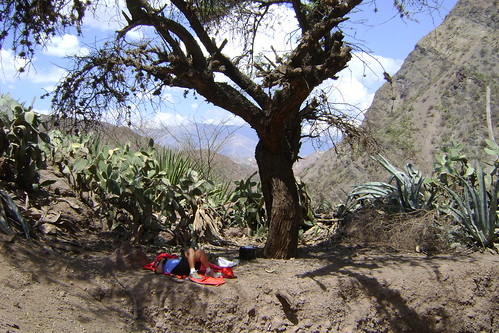
This is an attempt to answer a Frequently-Asked-Question, both at home and on the road: Don't you get tired?
I think there are two different questions being asked. The first is, "Don't you get physically tired riding all that way?". The short answer to that one is: Yes, we get physically tired, and we rest and that solves it.
But the other question people are asking us is, "Don't you get tired of it? or bored?". And that one has a more complicated answer.
Yes, we sometimes do get tired of it. Sometimes the road is the same for a few days. Or the scenery and challenges seem to remain the same. Or the challenge seems a bit too much for a while.
Our standard prescription for a bike tourist that gets discouraged is easy: Rest for some time, and it won't seem so overwhelming. We know of one cyclist who, after riding all the way across Europe in record time, suddenly started feeling like all the people in the country where he was riding were looking at him wrong, like they were out to get him. We think he was tired, and should have slowed the pace, or stopped to rest a few days. But he was on a flight home within a couple of days, having aborted his trip. Cyclists often don't know how tired they really are.
Another thing that's important is to avoid dwelling on the ultimate destination. Our ultimate destination is Ushuaia, in Tierra del Fuego, at the bottom of South America. That's still a long way away. read more here... lee mas aquí... »
Security and Bike Touring in Latin America
The first thing to think about when discussing security is safety on the road. We're far more likely to be hit by a car or truck than to be held up by a robber. And probably most accidents don't even involve a car. None of ours has. So route choice, careful riding, a good mirror, and the like are more important than thinking about weapons and robbers and assaults.
But we need to think about those things. They happen here, and so here is our thinking.
Some of our advice is easy: Learn as much of the language as you can so you can communicate about security and understand what people tell you. Don't get involved with crooks or narcotics dealers. Pretty obvious.
Then:
- Ask the locals about the security situation and listen to them.
- Don't listen to stories from other travelers unless the events happened to them personally. Only very rarely should you heed anything you hear about a country from people in another country. They just have built-in fears.
- When camping, (at least from Mexico to Bolivia) either camp with a family or in a town if you can. Or if you're stealth-camping, camp where nobody will ever know you were there.
- Try to find out about outrageously insecure areas (the road from San Cristobal to Palenque in southern Mexico, or the town of Paiján in northern Peru come to mind)
- Never leave anything unattended, even if it's locked. There's kind of a philosophy in the Latin world that if you leave something unattended you didn't really want it.
